Posts

The Last Duchess by Robert Browning

Image
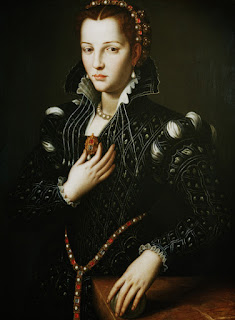
Robert Browning (1)     Robert Browning was a poet, who was born on May 7, 1812, in Camberwell, England (1). Browning's written work was widely unpopular but was known for his dramatic monologues. However, his techniques of diction, rhythm, and symbol became incredibly inspirational to aspiring writers of the twentieth century.      One of Browning's most notable works in the Bell's and Pomegranates series was unsuccessful at the time, yet captured one of his most popular poems, I. Italy  later got retitled as The Last Duchess (2). In 1838, Browning traveled to Italy, where his infatuation with the art and the cultural environment developed behind his inspiration for his many works (3) (4). However, Browning's inspiration for The Last Duchess came from the Renaissance Duke, Alfonso II of Ferrara, who had married his second wife by the name of Lucrezia de Medici (2). Lucrezia de Medici was from a family that was becoming one of the most powerful families in ...

The historical meanings behind Edgar Allan Poe "Black Cat"

Image
  Who is Edgar Allan Poe?- Brief introduction -He was born: on January 19, 1809, in Boston, Massachusetts, and died: on October 7, 1849, in Baltimore, Maryland. He is an American, short-story writer, poet, critic, and editor. He wrote some of the most famous works, like: "Macabre", "The Murders in the Rue Morgue", "Detective Theory, "Tales of Horror", and "The Raven". He is the son of Elizabeth Arnold Poe, an English-born actress, and a Baltimore actor named David Poe, Jr. When his mother died, he was taken in by a Richmond merchant named John Allan, who was presumed to be his godfather and his barren wife. In 1826 and 11 months in he went to school at the University of Virginia. He had a gambling problem which led to him not being able to go back to school. He later got engaged to a woman named Sarah Elmira Royster. In 1827 he went to Boston to publish a Pamphelt of Youthful Byronic poems, like "Tamerlane," and other poems. He joi...

Historical Male Supremacy in Robert Browning's "My Last Duchess"

Image
Robert Browning's "My Last Duchess" is a fascinating example of how Italian Renaissance-era men traditionally conformed to the pigeonhole of dominant, hyper-masculine personalities. In doing so, this often cast a shadow over the significance of women and furthered the gendered divide of society. This blog article explores this divide, breathes life into the duchess and defines her as more than just an artistic work, and identifies the relationship between vital historical context and the message eminent in Browning's work.  Portrait of Lucrezia de' Medici (1) Duchess of Ferrara- who was she? According to Wikipedia, Lucrezia de' Medici was born in Florence in the 14th century, and was the third daughter of Cosimo I de' Medici. Following under the strict Spanish court ceremonial, Lucrezia was introduced to Alfonso II d'Este in 1557, and contracted to marry him and become the Duchess of Ferrara. At the time that the two were married, Alfonso was 24 years ...

Poe's "Black Cat" Was Pro-Temperance

Image
                                           Poe’s Black Cat Was Pro-Temperance                                                            Illustration: From Victorian artist George Cruikshank's   series "The Bottle," 1847 (7, 8).      The crisis of character experienced by Poe's narrator in "The Black Cat" is multifaceted, and there is some historical context to explain the religious and moral panic he experiences. In the story, the narrator struggles on and off with alcoholism, and eventually begins abusing his pets and his wife. The moral downslide of a once-caring man is tragic and highly distressing for the man in question. He often makes reference to biblical c...

Poe's Montresor

Image
Edgar Allen Poe(4) Poe's Montresor  Edgar Allen Poe's short story "The Cask of Amontillado", is a mirror that reflects the life that its author led. If read only for the surface details, it is a suspenseful narrative in which a disgruntled and possibly deranged Montresor lures an unsuspecting wine aficionado, Fortunato, to his demise in a catacomb, as retaliation for supposed insults. Fortunato is given several opportunities to escape with his life intact by Montresor, but the promise of another drink drives him forward. As he is already inebriated as he descends into the crypt, he is also blind to the increasingly suspicious atmosphere of the duo's surroundings. Upon reaching the scene of the imminent crime, Montresor exploits his drunkenness one final time, shackling him to the interior of a gap in the wall, which Montresor then covers by laying a wall of bricks over the space, burying Fortunato alive within the tomb (3).  Fortundo entombed beneath the catacombs...

The Inspiration Behind "Where Are You Going, Where Have You Been?"

Image
Joyce Carol Oates Background      In 1966, Joyce Carol Oates published her award-winning short story, “Where Are You Going, Where Have You Been?” The inspiration for this story came from Charles Howard Schmid Jr, who had been responsible for the murder of multiple teenage girls in the early 1960s. Oates first read this case in a Life magazine article written by Don Moser. This article was titled, “The Pied Piper of Tucson: He Cruised in a Golden Car, Looking for the Action” (1). Charles Howard Scmid Jr.      Schmid was a small man, standing at just 5’3”. In an attempt to combat his insecurities, he would stuff his socks with rags in hopes to add a few inches. Although, just as Schmid's insecurities would grow, so would his madness. He blurted out “I want to kill a girl” while drinking alongside two of his future abettors (2). Charles Howard Scmid Jr.      His first victim would be Alleen Rowe, a fifteen-year-old high school sophomore. She...

The Murders Behind "Where Are You Going, Where Have You Been?"

Image
     Joyce Carol Oates' 1966 short story "Where Are You Going, Where Have You Been?" follows the story of the young Connie who is met with a tragic fate after a brief encounter with a strange man. The story sends chills down the spine of any reader, and righteously so. Despite an ambiguous ending, the reader is left with a frightening reminder of how often young women are targeted while embracing their transition into womanhood. To further enhance this fear, some readers would be shocked to learn that Oates' main inspiration for this story comes from the serial killer Charles Schmid - emphasizing how real Connie's situation can be. Charles Schmid      Oates first became familiar with the story of Charles Schmid through a Life  magazine article. She was fascinated by the details, but she did not read the entire article as to not soil her writing process (1). The article, titled "The Pied Piper of Tucson," describes Charles Schmid's persistent stalking...